
Castile-La Mancha: The land of El Greco and Don Quixote
Home to more than half of all vineyards in Spain and just an hour’s drive from Madrid, Castile-La Mancha makes the most sense for buyers who want to live the full Spanish experience.
Why Castile-La Mancha?
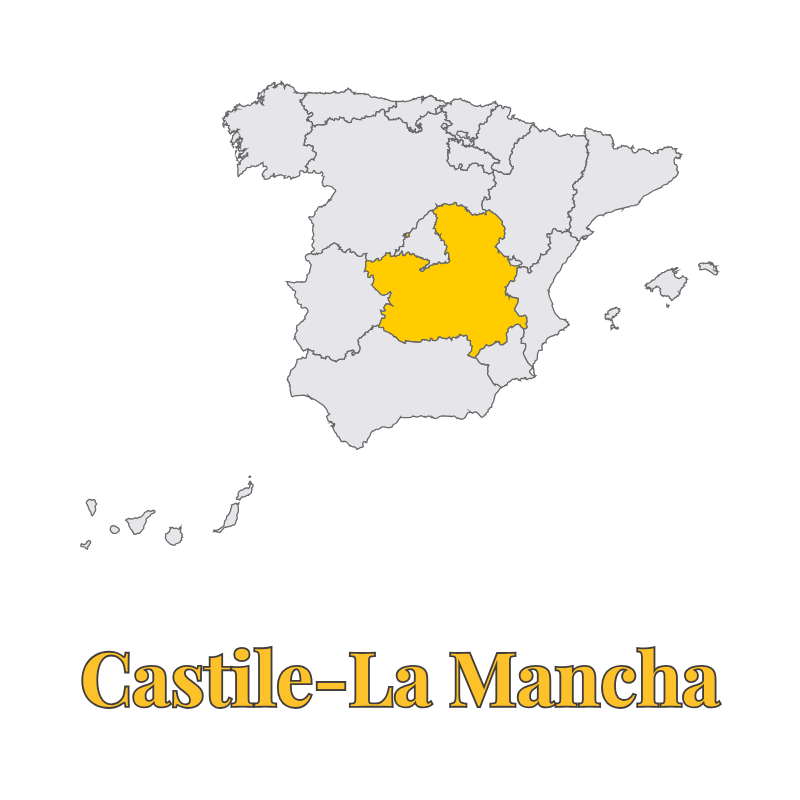
Castile-La Mancha sits right in the middle of Spain and covers five provinces: Toledo, Ciudad Real, Cuenca, Guadalajara and Albacete. It’s a big, internally varied region made up of plains, river valleys, historic cities, wetlands and mountain country, and includes two UNESCO-listed cities, Toledo and Cuenca. Cities in the region are just an hour or two from the capital, Madrid, while the Valencian coast is a three-hour train ride away. From a property point of view, it appeals to buyers who want more space, lower prices, and easy access to all of Spain’s charms and the full Mediterranean lifestyle.
That said, Castile-La Mancha is not a fantasy location. It’s hotter and drier than northern Spain, less internationally polished than Madrid or Barcelona, and large parts of it are more functional than glamorous. The regional market is also surprisingly uneven, from the very urban Toledo and Madrid-facing parts of Guadalajara to very different rural inland towns in Cuenca or Ciudad Real. The variety is also what makes the region incredibly interesting. It can offer real value, room to breathe, and a true town-and-country lifestyle that so many of us crave in modernity. In some places, the region offers a very workable base for buyers who want a spot in Spain without paying headline-market prices.
Historical Significance
This is one of Spain’s strongest regions if you care about cultural heritage and historical depth. Toledo is one of the country’s great historic cities and is explicitly recognised by UNESCO for the long coexistence of Christian, Jewish, and Muslim cultures. Cuenca, meanwhile, is a remarkably preserved fortified hill city known for its dramatic setting and hanging houses.
The trade-off is that heritage-heavy places aren’t always the easiest places to buy or renovate in. Historic centres can come with stricter building rules, tighter supply, older housing stock and more maintenance complexity than newer suburban or provincial markets. Still, from a property perspective, this kind of historic weight gives the region something many cheaper markets lack — places people already recognise, return to and value for reasons beyond price alone.
Relative affordability and cost of living
Compared to Madrid, Barcelona, the Balearics or the Costa del Sol, Castile-La Mancha is generally a lower-cost region. That shows up most clearly in housing, especially if you move beyond Toledo and the Guadalajara commuter belt. For buyers who care more about square footage, land, storage, parking or a garden than about prestige postcodes, the region can look very reasonable.
But “affordable” here needs context. Cheaper markets can also mean thinner resale demand, less international liquidity and fewer obvious rental plays. In some towns, prices are low because local demand is modest and population growth is not the story. That’s a real downside if your main goal is quick resale or easy holiday-letting upside. On the other hand, for long-term buyers, remote workers, families with a plan, or anyone priced out of Madrid, the lower-pressure market is often exactly the point.
Landscape and lifestyle
Castile-La Mancha’s landscape is broader and more varied than many people expect. Yes, there are the open plains associated with La Mancha, but there are also major wetland environments such as Las Tablas de Daimiel in Ciudad Real, and mountain and forest landscapes in places like the Serranía de Cuenca, where canyons, pine forests, and formations like the Ciudad Encantada give the province a very different feel from the central plains.
If you want to nitpick and look for a downside, it’s climate and scale. Summers can be very hot and some areas feel remote unless you’re comfortable driving regularly. For buyers who want breadth of land, open night skies (stargazing, or ‘astrotourism,’ is a regional hobby), hiking and less density, that’s not necessarily a problem.
Cultural Heritage
The Don Quixote association is real, but Castile-La Mancha is more than literary branding. The region has a strong local identity shaped by historic towns, religious festivals, craft traditions and a food culture that includes Manchego cheese, wines from La Mancha, and long-established different provincial cuisines. Official tourism and cultural resources also point to a wide spread of visitable heritage sites across the region, not just in Toledo and Cuenca.
But there’s always a ‘but’. This is not one of Spain’s most outward-facing regions. Outside the main cities and major tourism sites, daily life tends to be more local and less set up for foreign newcomers. For some, that makes integration harder. For others, it could be a plus, as the region feels lived-in rather than packaged for tourists, which translates to a more grounded ownership experience.
Whom Cantastile-La Mancha suits best
Buyers seeking a rental property or second home
Castile-La Mancha suits second-home buyers who want history, space and lower entry prices rather than a beach market or a glossy resort setting. It can work well for people drawn to places like Toledo or Cuenca, or to village and country properties with real character. As a rental play, though, it’s more selective than coastal Spain. Some city properties and heritage locations can make sense for medium-term or tourism-linked demand, but this is generally not the strongest region for buyers looking for easy, high-volume holiday letting.
Digital nomads and remote professionals
For remote workers, Castile-La Mancha can be a smart option if the goal is affordability, more space, and a calmer pace of life without being cut off from the rest of Spain. Toledo and Guadalajara are the most obvious fits because of their links to Madrid, while Albacete works better for buyers who want a practical regional city. The downside is that the region doesn’t have the built-in nomad scene, international networking culture or lifestyle branding of places like Valencia, Malaga or the Canary Islands. Still, for remote professionals who care more about livability than trend value, that can actually be a plus.
lFamilies relocating long term
For families, Castile-La Mancha can be a strong choice if the priority is more living space, lower housing costs and a quieter daily rhythm. Toledo, Guadalajara and Albacete are usually the most practical bases because they offer stronger services, schools, healthcare and transport links. The main trade-off is that the region does not offer the same international-school depth or expat-oriented infrastructure as Madrid, Barcelona or some coastal areas. Families who want a genuine long-term move into Spanish life often do well here; families looking for a very soft landing may find it more demanding.
Buyers relocating for employment
Castile-La Mancha can work for buyers moving for work, but usually in a more targeted way than Spain’s larger economic hubs. Guadalajara is the clearest example because of its connection to Madrid and the Henares corridor, while Albacete also has a more functional employment base than some of the region’s smaller cities. Even so, this is not the strongest region for buyers who need a very broad local job market. It makes more sense for people who already have a job lined up, can commute strategically, work remotely, or are moving with a business plan or savings behind them.
Property Market Considerations
Castile-La Mancha is not one property market. Toledo and parts of Guadalajara are heavily shaped by their relationship to Madrid. Cuenca and much of rural inland Castile-La Mancha are slower, more local and often more price-sensitive. Albacete has a more service-driven, practical market, while provinces like Ciudad Real can offer lower prices but also more selective demand. That means buyers need to stop thinking in regional slogans and start thinking in micro-markets.
In plain terms, this region often works best for buyers seeking one of four things: a historic city with cultural depth, a Madrid-adjacent value play, a practical inland base, or a slower rural purchase with land and space. It is less naturally suited to buyers chasing effortless holiday-rental demand or a ready-made expat ecosystem. As elsewhere in Spain, a local lawyer, a careful title and planning check, and a realistic view of resale depth matter much more than the initial asking price.
Top Locations to Consider
Toledo
Toledo is the region’s headline market for a reason. It has international recognition, extraordinary heritage, and very strong access to Madrid by high-speed Avant service. That combination makes it one of the few places in Castile-La Mancha that works both as a serious lifestyle city and, in the right circumstances, as a practical base for people whose professional or family orbit still includes the capital.
It’s also the most obvious market in the region, which means pricing in the old city and the better areas is less forgiving than people sometimes expect from inland Spain. Historic housing stock can also be beautiful but complicated. Still, if you want culture and a city that genuinely benefits from Madrid’s proximity, Toledo is usually where the shortlist starts.
Cuenca
Cuenca is one of the most distinctive small-city property markets in Spain. The old town’s topography, jaw-dropping hanging houses, striking gorges, and the endless visual drama of the setting give it a very unusual profile. It tends to appeal to buyers who want beauty, quiet, and a more contemplative kind of urban life rather than a fast-growth or high-consumption city environment.
Cuenca is a niche market though, and that’s putting it mildly. It’s smaller, less economically dynamic than Toledo or Guadalajara, and more likely to suit buyers prioritizing lifestyle, second-home use or a slower long-term relocation. For exactly that reason, though, it can be one of the region’s most interesting places to buy if your goal is character rather than momentum.
Albacete
Albacete is often underestimated because it doesn’t have the immediate historic branding of Toledo or Cuenca. In practical terms, though, it matters because it is one of the region’s main service and economic centres, with a larger-city feel, universities, transport links and a more everyday, functional kind of livability. That tends to make it more plausible for full-time family or professional life than some of the more picturesque but narrower markets in the region.
Its downside is that it’s not a romantic market, and buyers looking for medieval atmosphere or mountain scenery may find it too plain. But from a real-estate point of view, that lack of glamour can also mean fewer distortions. Albacete often makes more sense once you think in terms of day-to-day use rather than postcard appeal.
Guadalajara
Unlike Guadalajara in Mexico, a massive, bustling metropolis of over 5 million souls known as the capital of mariachi and tequila, the original Guadalajara in Spain is a quaint, quiet, historical city, population cca. 85,000, near Madrid. It’s the region’s most obvious Madrid ‘spillover’ market, located on the Henares corridor, and its rail and road links to the capital make it especially relevant for buyers who want more affordable access to central Spain without fully disconnecting from Madrid’s job market or airport ecosystem.
The catch is that its proximity to Madrid alone changes the character of the market. In the stronger commuter zones, prices are influenced less by classic Castile-La Mancha dynamics and more by capital-region demand. That can make Guadalajara less ‘cheap’ than buyers expect from the region as a whole. But for households whose real brief is value relative to Madrid, not value in the abstract, Guadalajara can be one of the smartest plays in the region.
Practical Considerations
Healthcare
Healthcare is one of the region’s more solid practical strengths, particularly in the provincial capitals and larger service centres. For full-time residents, that makes cities like Toledo, Albacete and Guadalajara more credible than many foreign buyers assume when they first think of inland Spain. The real issue is not whether the region has healthcare, but how far from it you want to live. As in much of inland Spain, rural living can mean more driving and fewer nearby specialist services. There's also the fact that nearby Madrid has some of the top hospitals and medical experts in the world.
Education
Castile-La Mancha works better for families in its larger cities than in its smaller rural towns. Toledo, Guadalajara and Albacete are the places where schooling, services and day-to-day logistics are most manageable. What the region is not especially known for is a deep bench of international schools on the scale you’d find around Madrid, Barcelona or parts of the Costa del Sol. That’s not necessarily a dealbreaker, but it does mean families should treat school strategy as part of the location search, not an afterthought.
Language and integration
Spanish is the language of daily life here, full stop. In the main cities and tourism centres, some English is available, especially in hospitality and among younger professionals, but Castile-La Mancha is not an English-buffered region. For long-term relocators, that’s both a challenge and an advantage: settling here usually requires more effort up front, but it also tends to lead to a more genuine level of integration.
Lifestyle and leisure
The lifestyle here is more about space, routine, food and local rhythm than about image. Manchego cheese, pisto manchego, migas and the wider La Mancha food tradition are not just tourism talking points; they’re part of the region’s identity. On the leisure side, the range is broader than many buyers expect: UNESCO cities, windmill country, wetlands in Daimiel, and mountain landscapes in Cuenca all sit within the same region.
The downside is that Castile-La Mancha does not sell itself as effortlessly as Spain’s coastal regions. There’s no beach premium, no island mythology, and fewer places that can be described as instant lifestyle brands. But for some buyers that’s exactly why it works. It feels less performative, less inflated, and more connected to how people actually live.
Educational Opportunities in Castile-La Mancha
Schools in Castile-La Mancha A Guide for Families
Lorem ipsum dolor sit amet, consectetur adipiscing elit. In quis efficitur nibh, nec ultricies dolor. Etiam ut lectus vulputate, hendrerit tortor tincidunt, pulvinar erat. Nunc orci odio, elementum eget sem vitae, congue viverra mauris. Curabitur vitae nunc vitae enim aliquet fermentum. Curabitur scelerisque dapibus diam ultrices convallis. Praesent eget scelerisque purus. Donec posuere ornare leo dapibus facilisis. Integer efficitur lacus nisl, ac efficitur orci facilisis a. Aenean sem justo, aliquet eu vehicula ut, egestas lobortis libero.